

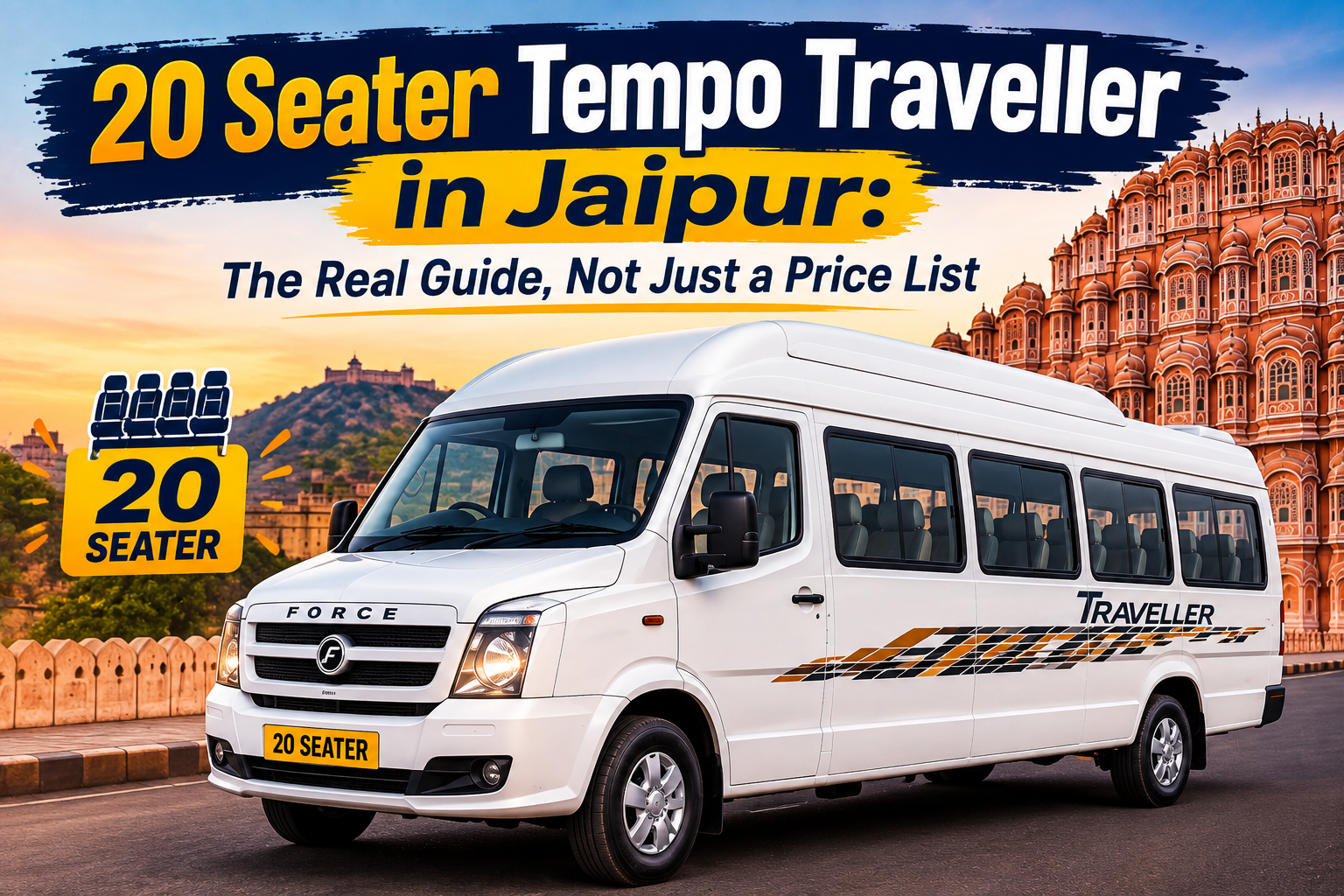
20 Seater Tempo Traveller in Jaipur: The Real Guide, Not Just a Price List
If you’ve started searching for a 20 seater tempo traveller in Jaipur, chances are your group has crossed that awkward size where a 12 or 16 seater just won’t cut it anymore, but you’re also not quite sure what actually changes once you go up to 20 seats. It’s a fair question. Most listings show you a price and a seat count and leave it at that, which is exactly why people end up either overpaying for a vehicle that’s half-empty, or booking something that technically fits everyone but turns into a cramped, luggage-in-the-aisle situation the moment the trip actually starts.
This one’s meant to actually walk through it — who really needs a 20 seater, what changes at this group size compared to smaller ones, how the pricing works, and what to check before you hand over an advance.
Who Actually Needs a 20 Seater
Not every group of 17-18 people needs the biggest vehicle on the list. Some genuinely do, some are better off splitting or downsizing. Here’s where a 20 seater tends to be the right call rather than an overspend:
Big family functions and reunions. When relatives are arriving from three or four different cities and the whole point of the day is keeping everyone together — moving from the hotel to the venue, venue to lunch, lunch to some sightseeing in between — a single large vehicle removes a lot of the coordination headache that comes with managing two or three smaller cars separately.
Corporate groups and office outings. Teams sitting right around the 17-20 mark are a very common case. The appeal here isn’t luxury, it’s simplicity — one pickup point, one driver, one schedule, and nobody left waiting on a second vehicle that’s running late.
School and college trips. Anywhere supervision matters, having the group physically together in one vehicle beats splitting them across multiple cars, purely from a manageability standpoint.
Multi-city circuits. A group doing a proper golden triangle tour India with tempo traveller across Jaipur, Agra, and Delhi will be living out of this vehicle for several days, so getting the size right at the start matters a lot more than it does for a single afternoon of local sightseeing.
Where it doesn’t make sense: if your actual confirmed count is closer to 14 or 15, you’re better off with a 16 seater tempo traveller in Jaipur. A 20 seater running three-quarters full still gets billed at full vehicle rate, and that gap adds up fast on anything longer than a day trip.
What Changes Once You Cross Into 20-Seater Territory
Seating capacity is the easy part to check. What people underestimate is how much luggage becomes the real constraint at this group size. Twenty travellers usually means twenty bags at a bare minimum — often more, if it’s a wedding group or a multi-day tour where people are carrying more than a change of clothes. If the roof carrier capacity isn’t confirmed in advance, you find out about the shortfall at the worst possible time: right at pickup, with everyone standing around watching the driver try to figure out where the last four bags are supposed to go.
AC performance is the other thing that quietly matters more than people expect. A vehicle that cools fine with eight or nine people can feel noticeably warmer with a full load of twenty, especially on a long outstation stretch in peak summer. It’s worth actually asking about this rather than assuming a bigger vehicle automatically means better climate control — sometimes it’s the opposite.
And then there’s trim level. The difference between a standard configuration and a luxury tempo traveller in Jaipur is genuinely small on a two-hour city loop between Amber Fort and Hawa Mahal, and genuinely noticeable on a five-hour drive to Udaipur. If your itinerary has any stretch longer than two or three hours in it, that upgrade is worth paying for — the seat cushioning and legroom difference isn’t marketing fluff, it actually changes how people feel getting out of the vehicle at the other end.
How the Pricing Actually Works
This is where most of the confusion happens, mostly because the pricing structure quietly changes depending on the kind of trip you’re booking, and nobody points that out upfront.
For local Jaipur sightseeing — a day spent hopping between forts, palaces, and markets — pricing is typically per day with a built-in kilometre cap. Go over the cap and you start paying extra per kilometre beyond it.
For outstation trips, the model flips. You’re usually looking at per-kilometre pricing with a minimum daily distance guaranteed, regardless of how far you actually travel that day. This matters because a short outstation day can still cost as much as a longer one, purely because of that minimum.
On top of whichever base structure applies, there are a few charges that almost never show up in the initial quote but are completely standard once you ask:
- Driver allowance, charged per day on any multi-day trip
- Night halt charges, if the vehicle and driver are staying overnight rather than doing a same-day return
- Tolls and parking, which are billed separately on almost every route and vary a lot depending on which cities you’re passing through
- Permit costs, relevant mainly for interstate routes
None of these are hidden fees in the shady sense — they’re just standard, and a decent operator will tell you upfront if you ask. The problem is that a lot of people don’t ask, compare quotes purely on the headline number, and then get surprised when the final bill is higher than expected. A two-minute conversation before booking a tempo traveller on rent in Jaipur — just walking through the full breakdown — avoids basically all of that.
Tempo Traveller vs Urbania at This Size
If your group is large and comfort is genuinely a priority rather than just a nice-to-have, it’s worth putting the Urbania platform next to the tempo traveller before you commit. A 16 seater Urbania in Jaipur rides noticeably better than a standard tempo traveller even at the base trim, and it’s a comparison that only takes a few minutes but can meaningfully change how a long trip feels, especially for older family members or anyone prone to motion discomfort on winding stretches.
Booking It as a Route, Not Just a Vehicle
For anything beyond a single city day — a wedding weekend, a multi-day outstation trip, or a full circuit — it’s worth booking the entire route as one package rather than negotiating each leg on its own. A golden triangle tour package with tempo traveller locks in the vehicle, the driver, and the day-by-day plan together, which means nobody’s scrambling to arrange local transport in Agra or Delhi mid-trip. It’s also usually cheaper than piecing together separate city-by-city transfers, since the operator isn’t repositioning the vehicle and driver between disconnected bookings.
If you’d rather have someone build the itinerary around the vehicle rather than the other way around, a tempo traveller for Golden Triangle tour booking usually comes with that groundwork already done — useful when you’re managing a large group and don’t have the bandwidth to plan each city stop separately.
What to Actually Confirm Before You Pay an Advance
Cut through all of the above and it comes down to a handful of concrete things worth nailing down before money changes hands:
- The confirmed traveller count — not the initial guest list, the number of people actually showing up
- Luggage and roof carrier capacity, checked against your real bag count, not a rough guess
- Whether the trip is priced per day or per kilometre, and what the cap or minimum distance is
- Driver allowance, night halt charges, and tolls — confirmed separately, in writing if possible
- Whether standard trim is enough or the trip length justifies the luxury upgrade
- Whether the full route is being booked as one package or as separate legs
None of this takes long to sort out, but it’s the difference between a booking that just works and one that turns into a series of small arguments over three or four days on the road. A 20-seater is a genuinely useful vehicle for the right group — it just needs a slightly more deliberate booking process than a quick, single-city trip does, mostly because there’s more that can go sideways with twenty people, their luggage, and a multi-day itinerary than there is with a four-hour local tour.
A Couple of Quick Answers
Is a 20 seater overkill for a group of 15? Usually, yes. A 16 seater fits more comfortably in terms of per-head cost, and you’re not paying for empty seats you don’t need.
Does the luxury trim matter for a single city day? Not much. It starts to matter once you’re on the road for more than two or three hours continuously.
Can I book just one leg of a multi-city trip instead of the whole route? You can, but it usually costs more and adds coordination work on your end. Booking the full route as one package tends to work out both simpler and cheaper.