

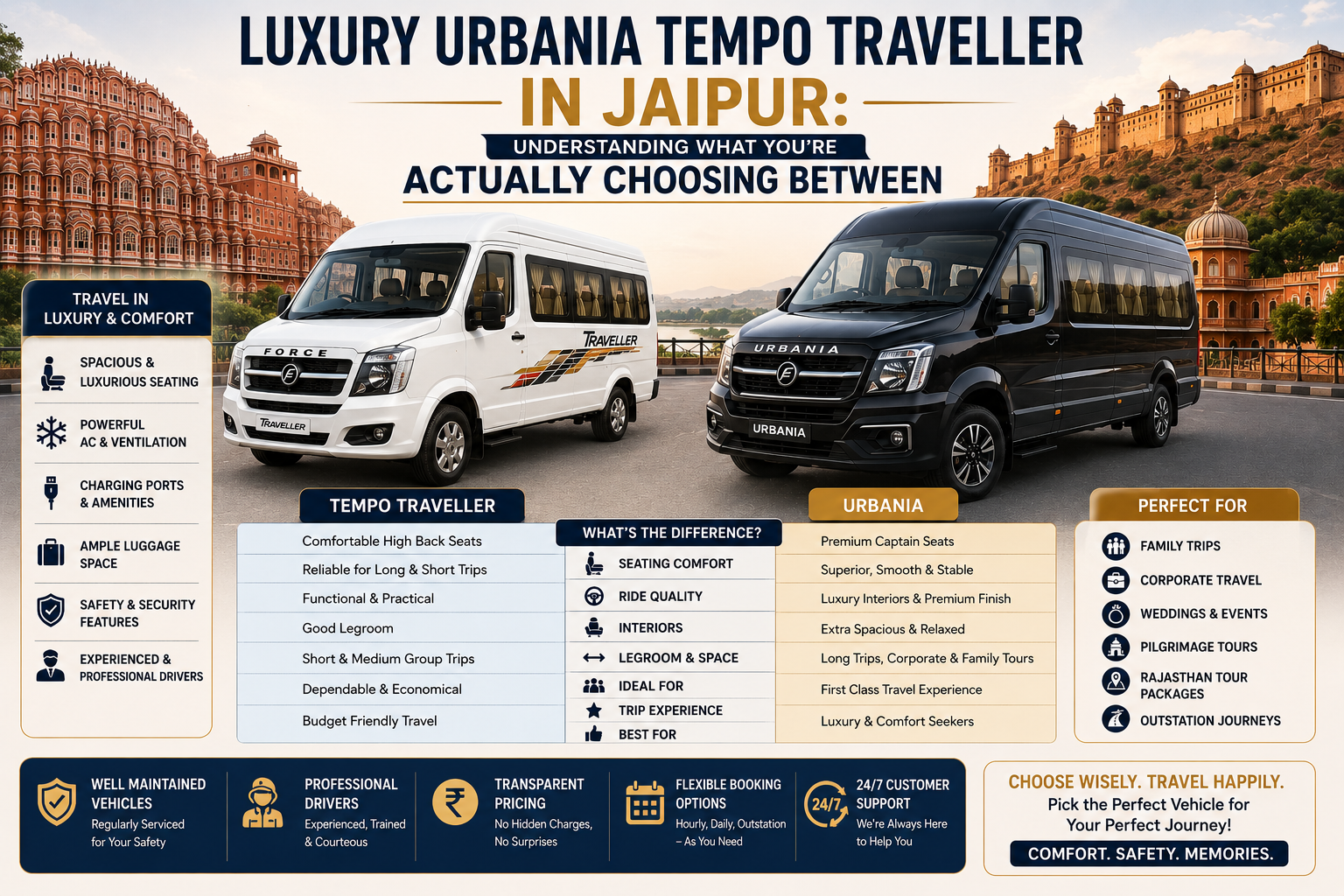
Luxury Urbania Tempo Traveller in Jaipur: Understanding What You’re Actually Choosing Between
Search this phrase and you’ll notice something odd — “luxury Urbania tempo traveller” gets used almost interchangeably across listings, as if Urbania and tempo traveller are the same thing with a luxury label slapped on top. They’re not. They’re two different vehicle platforms, each with their own standard and luxury tiers, and understanding that distinction before booking saves you from comparing quotes that aren’t actually comparable.
This one’s meant to untangle that confusion properly, not add to it.
Two Vehicles, Not One Category
A tempo traveller and an Urbania are built on different chassis, with different suspension setups and cabin proportions. The tempo traveller has been the long-standing default for group travel in Rajasthan — widely available, well understood by every local operator, and priced predictably. The Urbania is the newer entrant, generally offering a smoother ride and slightly more cabin space per seat, particularly noticeable on longer highway stretches rather than short city hops.
Both platforms come in standard and luxury configurations. So when a listing says “luxury Urbania tempo traveller,” it usually means the operator offers luxury trim across both vehicle types, and the actual decision you’re making has two separate layers — which platform, and which trim level — rather than one single choice.
Layer One: Tempo Traveller or Urbania
This decision mostly comes down to how much continuous driving your trip involves. For local Jaipur sightseeing — a day spent between Amber Fort, Hawa Mahal, and City Palace — the difference between the two platforms barely registers. Rides between stops rarely exceed twenty or thirty minutes, and a standard tempo traveller on rent in Jaipur handles that just fine without needing the Urbania’s smoother ride quality.
Outstation trips change the calculation. A run to Pushkar or Udaipur, or a longer circuit like a golden triangle tour India with tempo traveller, involves multiple hours of continuous highway driving, and that’s where the Urbania’s smoother suspension and marginally roomier cabin start to matter. If you’re weighing the two platforms specifically for an outstation trip, it’s worth comparing a golden triangle tour India with Urbania quote directly against the tempo traveller equivalent before deciding — same route, same day-by-day structure in most cases, just a different vehicle underneath and a different price attached.
Layer Two: Standard or Luxury Trim
Once you’ve settled on a platform, the second decision is whether to pay for the luxury tier within it. This layer is really about trip length rather than group size or destination. A short local day rarely justifies the luxury premium on either platform — nobody’s seated long enough for cushioning and AC consistency to matter much. A luxury tempo traveller in Jaipur or a luxury Urbania both earn their higher price specifically on trips with real driving distance built in — outstation legs, multi-day circuits, anything crossing the two-to-three-hour mark of continuous travel.
The luxury upgrade generally means better-cushioned seating, AC that holds up more consistently under a full passenger load, and a bit more legroom per seat compared to the standard configuration on the same platform. It’s a genuine difference, not just marketing language, but it only shows its value on trips long enough for the group to actually notice it.
Matching Vehicle Size to the Group
Both platforms come in a similar range of seat configurations, so sizing the vehicle correctly matters regardless of which one you’re leaning toward. For smaller groups, around eight or nine travellers, a 9 seater tempo traveller in Jaipur or its Urbania equivalent covers the trip without paying for unused capacity. For mid-sized groups, ten to twelve people, a 12 seater tempo traveller in Jaipur tends to be the standard pick for extended families or small tour groups. For larger groups, a 16 seater tempo traveller in Jaipur keeps everyone together across multi-stop days without splitting into two vehicles. And for groups pushing past sixteen, a 20 seater tempo traveller in Jaipur is usually the right call for large family functions or bigger corporate groups.
A half-empty larger vehicle costs more per head than a well-matched smaller one, and this holds regardless of trim level — paying luxury prices for unused seats is a worse deal than paying luxury prices for a vehicle that’s actually sized to your group.
Reading a Combined Listing Correctly
When an operator markets a “luxury Urbania tempo traveller” package as a single offering, it’s worth asking directly which platform is actually being quoted, since the two aren’t interchangeable despite the shared listing title. Ask for the specific vehicle type, the seat configuration, and confirm the trim level separately from the platform choice. A good operator will happily break this down; a vague answer here is usually a sign the listing is using both terms loosely to capture search traffic rather than genuinely offering a considered choice between them.
What the Pricing Actually Includes
Local trips are typically priced per day with a kilometre cap built in, regardless of platform or trim. Outstation trips flip to per-kilometre pricing with a minimum daily distance guaranteed. On top of the base rate, the standard add-ons apply across both tempo traveller and Urbania bookings: driver allowance on multi-day trips, night halt charges for any night the vehicle stays over outside its home base, and tolls or parking along the route, which are almost never folded into the base fare.
None of this changes based on which platform or trim you choose, but it’s worth confirming the full breakdown before comparing quotes across operators — a luxury Urbania quote that looks close to a standard tempo traveller quote on paper can end up meaningfully different once everything’s actually added in.
The Decision, Simplified
Strip away the combined marketing language and this really comes down to two separate questions asked in order: does your trip have enough continuous driving distance to justify the Urbania’s smoother ride over a tempo traveller, and does it have enough total travel time to justify luxury trim over standard. Answer both honestly based on your actual itinerary rather than how appealing the word “luxury” sounds on a listing page, and the right combination becomes fairly obvious — sometimes that’s a luxury Urbania for a long outstation circuit, sometimes it’s a standard tempo traveller for a straightforward city day, and most trips land somewhere sensibly in between.

