

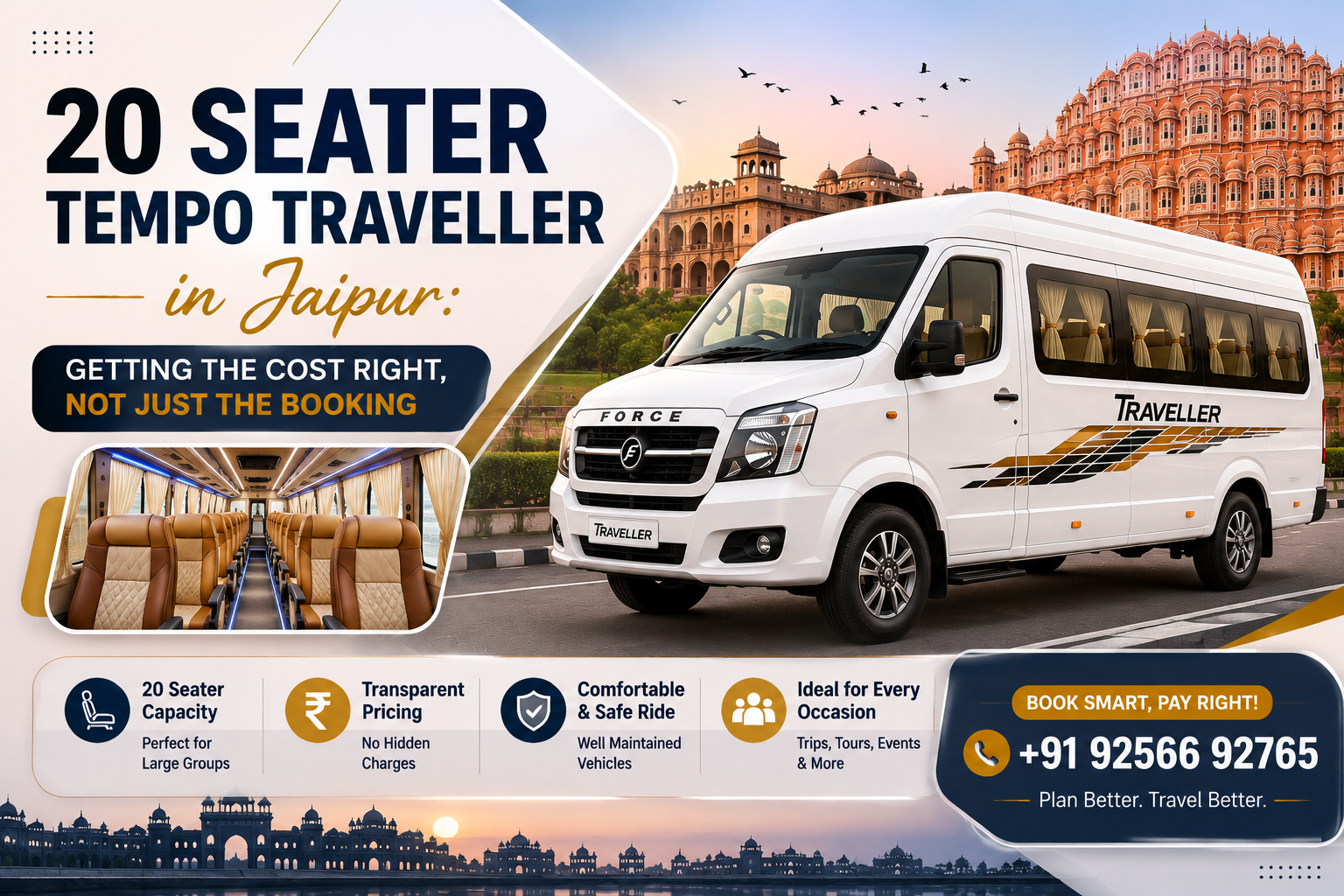
20 Seater Tempo Traveller in Jaipur: Getting the Cost Right, Not Just the Booking
Most guides on this topic focus on which vehicle to pick. Fewer talk about the actual money side of a 20 seater booking, which is where a lot of people end up either overpaying without realising it or, in trying to save money, cutting corners that end up costing more once the trip’s actually underway. This one’s about the cost side specifically — what drives the price, where the room to save actually is, and where it isn’t.
Why 20 Seaters Get Priced the Way They Do
A 20 seater tempo traveller in Jaipur sits at the upper end of the group vehicle range, and its pricing reflects that in a few specific ways. Fuel consumption is higher than smaller vehicles, maintenance costs more given the size of the engine and the wear from carrying a full load regularly, and fewer operators actually run this size in their fleet compared to the more common 9, 12, and 16 seater options. That combination of higher running cost and lower availability is why the per-day or per-kilometre rate tends to sit noticeably above smaller vehicles, not just proportionally but sometimes disproportionately during peak season.
Knowing this upfront helps set realistic expectations. A 20 seater isn’t simply “a bit more than a 16 seater” — it’s often a meaningfully different price bracket, and comparing it against smaller vehicle rates on a per-seat basis can be misleading if your actual group doesn’t need the full capacity.
The Real Question: Do You Need Twenty Seats
Before getting into cost-saving specifics, it’s worth revisiting whether 20 is actually the right number. If your confirmed headcount is closer to fifteen or sixteen, a 16 seater tempo traveller in Jaipur is very likely the smarter booking — not just slightly cheaper, but often meaningfully so, since you’re stepping down a full pricing bracket rather than just trimming a few seats off the same rate. The same logic applies further down — a group of ten to twelve is genuinely better served by a 12 seater tempo traveller in Jaipur, and a smaller group of eight or nine by a 9 seater tempo traveller in Jaipur.
This sounds obvious written out, but in practice, people book based on the biggest number that got mentioned during planning — “maybe twenty of us” — rather than waiting for the actual confirmed count. If your event is still a few weeks out and the guest list isn’t locked, it’s worth holding off on booking the vehicle size until you have a firmer number, even if that means booking slightly later than you’d ideally like.
Where the Hidden Costs Actually Come From
The quoted rate on most listings covers the vehicle and driver for a base package — typically a fixed number of hours or kilometres for local trips, or a day rate with a distance cap for outstation ones. What it usually doesn’t include, and what catches first-time large-group renters off guard, is a specific set of standard add-ons. Driver allowance gets charged daily on multi-day trips. Night halt charges apply for any night the vehicle stays over outside its base city. Tolls and parking are billed separately on almost every route, and with a vehicle this size, parking in particular can be a real consideration in crowded areas of Jaipur where a 20 seater simply can’t fit into the same spots a smaller car would.
None of these are hidden in a dishonest sense — they’re standard practice — but they’re easy to miss if you’re only comparing the headline number across a few quotes. Ask for the full breakdown before comparing, not after you’ve already picked a favourite based on price alone.
When Paying More Actually Saves Money
This sounds counterintuitive, but it’s true often enough to mention directly. For a multi-day trip or a wedding weekend, a luxury tempo traveller in Jaipur at 20 seats can end up being better value than it first appears, mainly because a group this large spread across a poorly cooled, uncomfortable standard vehicle for several days tends to generate its own costs — irritability, complaints, someone needing an unplanned break that adds time and sometimes money to the schedule. The luxury upgrade isn’t free, but for a trip with real driving distance built in, it can prevent the kind of friction that ends up costing more in indirect ways than the price difference itself.
The same logic applies to comparing against the Urbania platform. A 16 seater Urbania in Jaipur, while a different seat count, is worth checking against a 20 seater tempo traveller quote if your actual group is closer to sixteen — sometimes the smoother ride and better cabin space of the Urbania at the right size ends up costing about the same as a bigger, standard tempo traveller, while delivering a noticeably more comfortable trip.
Booking Timing and Its Effect on Price
Because 20 seaters are less common in most operators’ fleets, availability tightens faster than it does for smaller vehicles, especially during Jaipur’s wedding season from October through February. Booking close to the date during peak season doesn’t just risk unavailability — it often means paying a premium for whatever’s left, since the operator knows demand is high and supply is limited. Locking in the booking two to three weeks ahead, sometimes more for peak wedding dates, tends to get better pricing than a last-minute scramble, purely because you’re negotiating from a position where the operator still has multiple vehicles to offer rather than one remaining option.
Multi-City Trips Change the Cost Calculation Entirely
If your 20-seater group is doing more than a single Jaipur-based event — say, a circuit like a golden triangle tour package with tempo traveller — booking the entire route as one package is almost always cheaper than arranging separate transport in each city. This is true for any group size, but it matters more with a 20 seater specifically because repositioning a vehicle this large between cities, or arranging a second one locally in Agra or Delhi, tends to be both harder to coordinate and more expensive than keeping one vehicle and driver for the whole loop. A tempo traveller for Golden Triangle tour booking that covers the full circuit in one package is usually the more cost-effective route for a group this size doing a multi-city trip.
A Simple Way to Check You’re Not Overpaying
Get at least two full quotes, not just headline prices, and compare them on the same terms — same trip length, same trim level, same inclusions. Confirm your actual headcount before finalising the seat size, since stepping down even one bracket can mean a meaningfully lower rate. Ask specifically about driver allowance, tolls, and night halts on both quotes rather than assuming they’re bundled the same way. And if your group size is borderline between two vehicle sizes, get quotes for both rather than assuming the bigger one is automatically the safer or better-value choice — sometimes it is, and sometimes the smaller vehicle with a slightly tighter fit still works out cheaper overall once everyone’s luggage and the trip length are actually factored in.

