

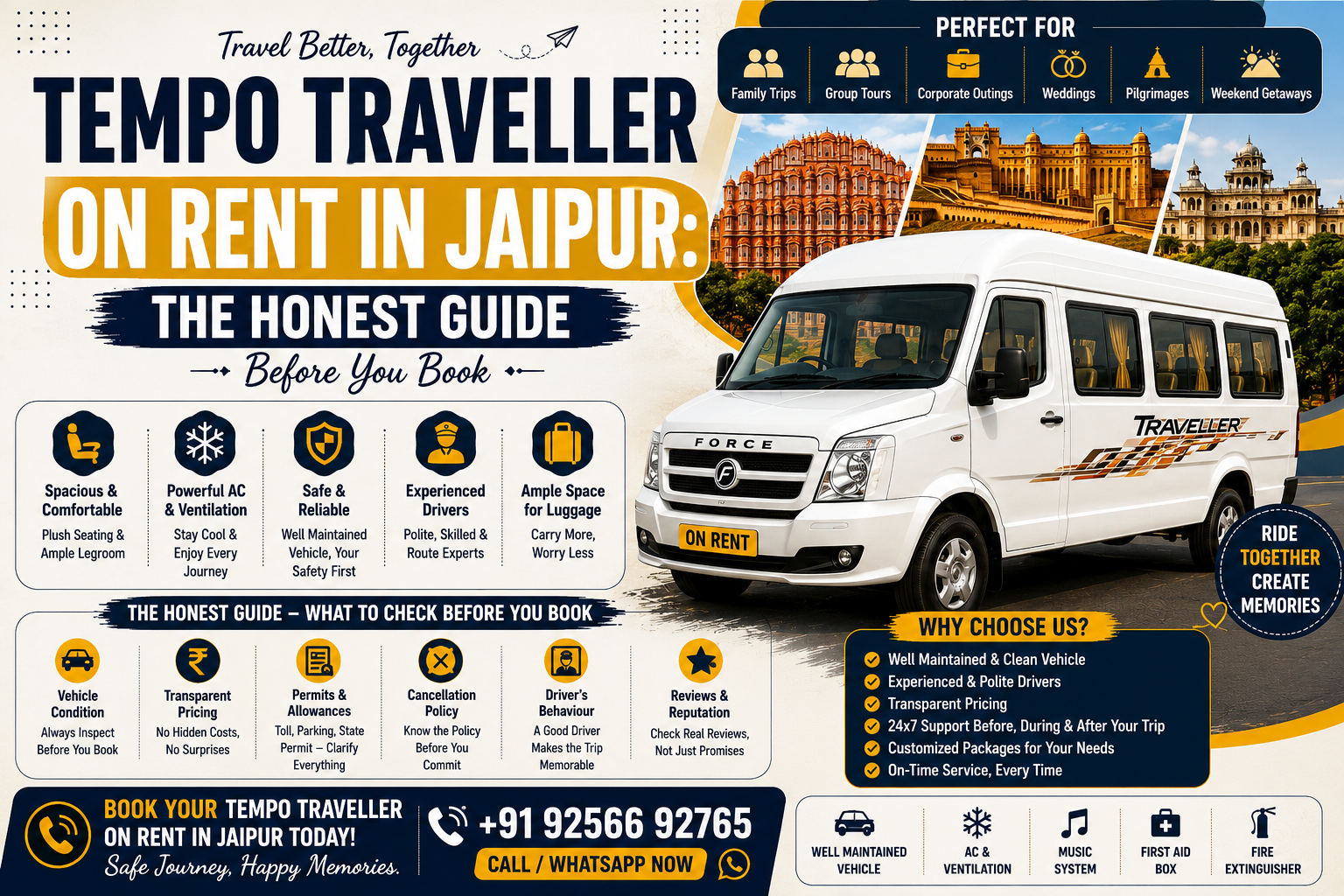
Tempo Traveller on Rent in Jaipur: The Honest Guide Before You Book
What You’re Actually Renting
Nobody rents a tempo traveller because they want a tempo traveller. They rent one because a group has to move — a family across Rajasthan, guests between a hotel and a wedding venue, a team from the airport to a site visit — and cars have stopped making sense.
That’s worth saying plainly, because it changes what you should be shopping for. You are not buying a vehicle. You are buying a day of transport: a driver who knows the route, a cabin that stays cool at two in the afternoon in June, luggage that arrives with the people it belongs to, and a final bill that looks like the number you were quoted.
Almost everything that goes wrong with a tempo traveller booking in Jaipur goes wrong in one of those four places. Not one of them is visible in a photo. Which is why this guide spends most of its time on the questions to ask rather than on the seats.
Step One: Get the Size Right
Size is the only decision you can’t fix later, so make it first — and make it with your actual list in front of you, not the list you assume will hold.
Seven to eight people. The 9 seater tempo traveller in Jaipur is the cheapest sensible option and it fits this group without any squeezing. Booking bigger “just in case” costs real money every single day of the trip.
Nine to eleven people. The 12 seater tempo traveller in Jaipur is the workhorse of the whole category and the most commonly booked size in the city. Note the gap: twelve seats are comfortable for about ten to eleven people once everyone has a full suitcase.
Twelve to fifteen people. The 16 seater tempo traveller in Jaipur — and this is where people most often try to save money by going one size down. Don’t. Fifteen adults in a twelve-seater body for six hours on the Jodhpur highway is the single most common regret in this business.
The rule that saves the most trouble: book for your worst-case headcount, not your best case. A seat added on the morning of departure is expensive and sometimes impossible. A seat booked and unused costs you a fraction of that.
The second rule: count bags separately from people. A standard tempo traveller carries a roof carrier, which means large suitcases ride up top and the cabin stays livable. This is a bigger deal than most first-time renters realise, and it’s the one thing the premium option gives up.
Step Two: Standard or Urbania
Two different platforms, sold on the same page, priced differently for real reasons.
A standard tempo traveller is a cabin built onto a ladder chassis. It’s durable, it’s everywhere, it takes a roof carrier, and it’s the honest value choice. A well-kept one with recliner seats and roof-mounted AC — what gets sold as a luxury tempo traveller in Jaipur — handles a four-day Rajasthan itinerary perfectly well.
The Force Urbania is built differently: one welded monocoque shell, the way a car is. Lower floor, easier step-in for elderly passengers, standing headroom in the aisle, much less body roll through the ghats, and a noticeably quieter cabin at highway speed. Over five or six hours in the seat, that difference stops being a spec and starts being the reason nobody is irritable when you arrive.
It costs more per day, and it cannot take a roof carrier — no ladder frame up there to bolt one to — so every bag travels inside. That’s the trade, stated honestly. The sizes run the same way: 9 seater Urbania for a small group that wants the best possible ride, 12 seater Urbania for a family or client team, and 16 seater Urbania when the headcount is high and comfort still can’t be sacrificed. If you’re weighing the platform as a whole rather than one size, the Urbania tempo traveller rental in Jaipur page lays out the range.
Short version: standard body for luggage-heavy trips and tight budgets. Urbania for long highway days, elderly passengers, and anything where the vehicle is part of the impression you’re making.
Step Three: Understand What the Rate Actually Means
This is where quotes stop being comparable, and where most of the arguments happen.
Kilometre cap. Almost every Jaipur rental is priced against a daily cap, usually 250 to 300 km. Cross it and a per-kilometre charge applies. Multi-city Rajasthan itineraries cross it routinely — Jaipur to Jodhpur alone is well past 300 km one way. Get the cap and the beyond-cap rate in the same message as the price.
Garage to garage. Kilometres are usually counted from the operator’s garage and back, not from your gate. It isn’t a trick, but it does mean the meter starts before you get in. Ask how it’s being measured so the closing number isn’t a surprise.
Driver allowance. Food and accommodation for the driver on overnight trips. Some quotes include it, some leave it for you to settle at the end. Neither is wrong. Not knowing which one you agreed to is.
Night charges. Usually applies to running between roughly 10 p.m. and 6 a.m. Relevant for late flights, early temple departures and wedding movement.
Tolls, state permits and parking. Any route crossing into Uttar Pradesh, Haryana or Delhi carries state permit costs. A Golden Triangle run crosses two borders. These are legitimate charges — they just belong in the quote rather than in a phone call afterwards.
Ask for one all-inclusive figure covering all of it. Two quotes that look far apart are usually the same total, dressed differently, and the cheaper-looking one is frequently the one with more to add later.
Step Four: Verify the Vehicle, Not the Category
Book the category and you get whatever is free that morning. Book a vehicle and you get a vehicle.
Ask for photos of the exact unit assigned to you — cabin, seats, boot, exterior — dated, not brochure stock pulled off a website.
Ask for the RC year as a plain number. How fast that answer comes back tells you as much as the answer itself.
Ask what the AC is. Roof-mounted AC or a dashboard blower is the biggest comfort variable in a Rajasthan summer and it never shows up in a photograph.
Ask whether it’s actually an Urbania, if that’s what you’re paying for. “Urbania-type” and “luxury Urbania” get attached to well-kept standard vehicles more often than the trade likes to admit. The model name is on the RC. Ask to see it.
Ask about the driver. Route familiarity, years driving, and whether he speaks a language your group can use. On a four-day trip the driver has more effect on how it goes than the upholstery does.
The Routes Jaipur Fleets Run Most
Jaipur city and airport duty. Half-day and full-day sightseeing, guest pickups, corporate movement. Short runs where the size matters more than the trim level.
Jaipur–Ajmer–Pushkar. The most-booked weekend circuit in the fleet. Two and a half to three hours each way, easy roads, usually mixed ages.
Khatu Shyam Ji, Salasar and Nathdwara. Temple circuits with early departures and a lot of stopping. Confirm parking and approach for your dates — mela weeks rewrite the plan for every vehicle on the road.
Ranthambore, Bharatpur and Sariska. Weekend wildlife runs. Ask plainly whether the assigned vehicle has done your exact last stretch, because some approach roads are rougher than the booking photos suggest.
Jaipur–Jodhpur–Udaipur–Jaisalmer. Full Rajasthan circuits, five to seven days, real distance. This is where kilometre caps, vehicle age and seat comfort all stop being theoretical at once.
The Golden Triangle. Jaipur–Agra–Delhi, three to four days, two state borders, bags in and out daily. The Golden Triangle tour with tempo traveller page covers the day-by-day shape of it properly, including where the permit costs land.
Frequently Asked Questions
How much does a tempo traveller cost per day in Jaipur? There’s no honest fixed number, and any operator who gives you one without seeing your itinerary is guessing. Kilometres move the price more than days do, and trim level moves it again. Send the exact route and ask for one all-inclusive figure.
Is the driver included? Always. Self-drive doesn’t exist in this category in Rajasthan. Just confirm the driver’s food and stay allowance is inside the quote rather than waiting at the end of it.
What happens if we exceed the kilometre limit? A per-kilometre charge applies on the excess. It’s normal and it’s fair — the mistake is not knowing the rate before you start, so ask for it up front.
Can we take the vehicle outside Rajasthan? Yes, with the relevant state permits, which carry a cost. Tell the operator every state on your route when you ask for the quote.
How early should I book? Four to five days in normal season. Seven to ten days around wedding muhurats, Diwali, the Pushkar fair window and long weekends. The well-maintained vehicles get committed first, and what’s left over in peak week is exactly what people write bad reviews about.
Standard tempo traveller or Urbania — which should I pick? Standard if you’re carrying heavy luggage or watching the budget. Urbania if the itinerary has long highway hours, elderly passengers, or clients aboard.
Final Word
Renting a tempo traveller in Jaipur is not a complicated purchase. It only feels complicated because the things that decide whether the trip goes well — vehicle age, AC type, the real kilometre cap, whether the driver knows the road — are all invisible at the moment you’re choosing, and none of them are what the photos are showing you.
So do the four things that actually work. Count your people with their bags physically in hand and size up, not down. Decide honestly whether you’re buying comfort or capacity. Get one all-inclusive number in writing with the kilometre cap inside it. And ask for photos and the RC year of the specific vehicle coming to your gate.
Do that, and getting a tempo traveller on rent in Jaipur becomes what it should have been all along — the easy part of the trip, settled a week before anyone packs.

