

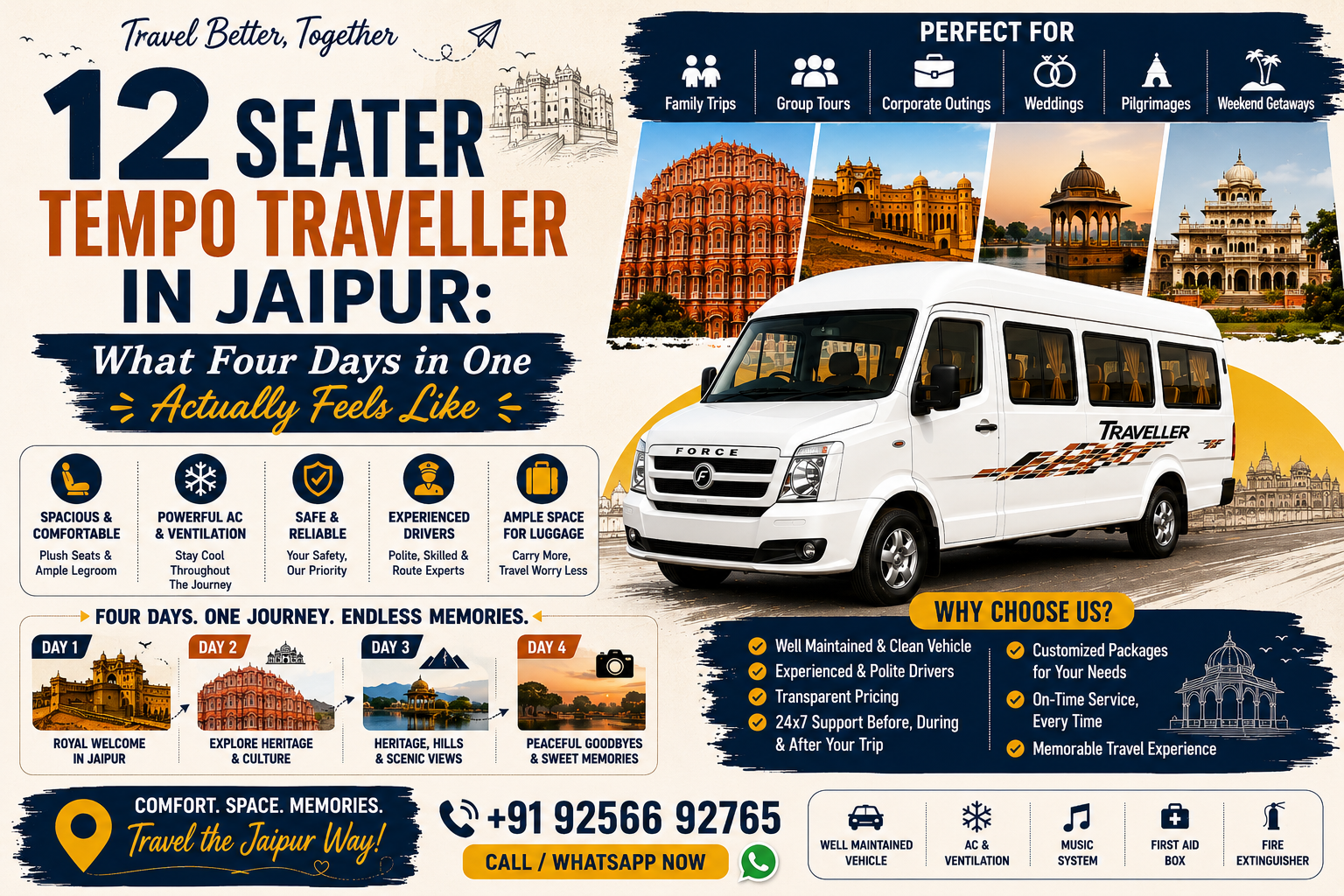
12 Seater Tempo Traveller in Jaipur: What Four Days in One Actually Feels Like
Every 12 seater listing in Jaipur tells you the same three things. Twelve seats. Pushback or recliner. AC available.
None of that tells you what you actually want to know, which is: what is this vehicle like on day three, at 4 p.m., somewhere between Jodhpur and Udaipur, with your mother-in-law in the back row and everyone’s luggage already unloaded and reloaded five times?
That’s the real product. So let’s talk about that instead of the spec sheet.
The Seat Map Is a Decision, Not a Detail
Twelve passengers plus the driver. Two-by-two rows down the cabin, and a four-across bench at the back.
That last row is the honest weak point of this size, and it’s worth understanding properly rather than discovering it. It has less recline than the rows ahead. The armrests are compromised because four people are sharing the width. And on one side the rear wheel arch intrudes into the footwell, so somebody’s feet spend the trip at a slightly wrong angle.
On a two-hour run to Pushkar, nobody notices any of this. On the seven hours to Jaisalmer, the people back there will have formed opinions by lunch.
So: decide seating before departure, not in the driveway. Middle rows for elderly passengers, anyone prone to motion sickness, and anyone who’ll be uncomfortable admitting they’re uncomfortable. Last row for the two youngest adults who genuinely don’t mind. Rotate it on multi-day trips and the whole conversation disappears.
That single piece of planning does more for a four-day trip than most paid upgrades.
Hour by Hour, on a Long Day
The first two hours. Everything is fine in every 12 seater ever built. Base trim, luxury trim, doesn’t matter. Nobody has discovered anything yet.
Hours two to four. The AC reveals itself. If you have a dashboard blower, the front two rows are comfortable and the back two are not — cold air doesn’t travel twelve seats deep, and it never has. This is the point at which somebody starts fanning themselves with a phone. If you have roof-mounted ducting, this hour passes without comment.
Hours four to six. Seat quality arrives. A pushback seat holds up fine for four hours and starts to feel thin after five. A proper recliner with lumbar shape is the difference between arriving tired and arriving irritated. This is what you’re actually buying when you pay more for a luxury tempo traveller — not the LED strips and the curtains, but hour five.
Hours six and beyond. Ride quality takes over from everything else. The tempo traveller is built on a ladder frame, which is why it can carry a roof carrier and why it costs less to run — but it’s also why broken road transmits through the cabin in a way that stops being background noise after six hours. Nobody complains about it. Everyone is quieter than they were at hour two.
That last hour is the entire argument for the 12 seater Urbania, and we’ll get to it.
Luggage: The Feature That Decides the Trip
The boot behind the last row of a 12 seater takes day bags, a water crate and maybe two small trolleys. It does not take twelve suitcases. Anyone who tells you otherwise has not personally loaded twelve suitcases.
What makes this vehicle work is the roof carrier. Big bags go up top under a tarp and rope, the boot stays free for the things you actually need during the day, and the aisle stays walkable — which matters more than people expect, because an aisle full of bags means nobody moves seats, nobody reaches the water, and every rest stop takes twice as long.
Twelve adults with full multi-day luggage is a completely normal configuration on this body with the carrier fitted. Without it, it’s a bad four days.
So say the number out loud when you book. Not “we have some luggage” — say “eight large suitcases and six cabin bags.” The carrier gets fitted and roped the evening before instead of improvised at 5 a.m. while everyone stands around watching.
This is also the single clearest advantage the tempo traveller holds over the entire Urbania platform, which cannot take a roof carrier at all.
The Summer Question
Between March and September in Rajasthan, AC type is not a feature comparison. It’s the trip.
Roof-mounted ducting cools all twelve seats. A dashboard blower cools four of them and gives the other eight a rumour of cool air. Photographs never show which one a vehicle has, brochures rarely mention it, and it is the most common cause of a bad review in this category.
Ask directly: roof AC or dashboard blower? If the answer is vague, that’s an answer.
Where the Urbania Wins — and Where It Doesn’t
This site sells both, so here’s the honest version.
The Urbania is monocoque — one integrated body shell rather than a body bolted onto a frame. In practice: less shudder over bad road, noticeably quieter at highway speed, a lower step-in that elderly passengers will silently appreciate every single time they board, and considerably less fatigue at the end of a long day.
If your trip is Jaipur–Udaipur–Jodhpur with grandparents aboard, that’s not a luxury. That’s the reason the trip goes well.
The trade is absolute: no roof carrier. Every bag rides inside the cabin with you, which eats seats or aisle or both. For a business group with cabin bags, irrelevant. For a family of twelve heading to a wedding, decisive.
So the rule is short: if luggage is your constraint, take the tempo traveller. If hours in the seat are your constraint, take the Urbania.
If you land on the Urbania side, the 16 seater Urbania covers larger groups, the 9 seater Urbania is the most comfortable thing in this category for a smaller party, and the broader Urbania on rent range sits between them. The luxury Urbania trims are the top of the comfort ladder in Jaipur.
Is Twelve Actually Your Number?
Worth ten seconds, because paying for the wrong size is the expensive mistake here — not paying too much for the right one.
- Six to eight people. The 9 seater tempo traveller does the same job for less per day, parks more easily, and still takes a roof carrier.
- Nine to twelve. This is your size, and it’s the most comfortable at ten or eleven rather than a full twelve.
- Thirteen or more. The 16 seater tempo traveller, without argument. Squeezing thirteen people into twelve seats is not a plan, and a seat added on the morning of departure costs far more than a seat booked four days earlier.
The full ladder across sizes and platforms sits on the tempo traveller on rent page if you want to see where your group lands.
The Routes This Size Was Built For
Golden Triangle. Jaipur–Agra–Delhi over three or four days, bags loaded and unloaded twice daily. The roof carrier does more work here than any feature inside the cabin, which is why a Golden Triangle tour with tempo traveller remains the default for a group of this size.
Jaipur–Jodhpur–Udaipur. The route that tests everything discussed above. Six to seven hour stretches, real bags, mixed ages.
Ranthambore, Pushkar, Ajmer, Bharatpur. Two to four hours each way, one overnight. Statistically the most common 12 seater booking in Jaipur, and the size is almost perfectly specified for it. Base trim is genuinely enough here.
Khatu Shyam Ji, Salasar, Nathdwara. Easy roads, 4 a.m. starts, elderly passengers, a stop every ninety minutes. Confirm parking and approach for your exact dates — mela weeks rewrite the plan for every vehicle on the road.
Mount Abu and the Aravalli ghats. Ask for a newer vehicle. Engine and brake condition matter far more on gradients than anywhere else in Rajasthan.
Six Things to Confirm Before You Pay
- RC year, as a plain number. How quickly that comes back tells you plenty about the operator.
- AC type — roof-mounted or dashboard blower. Ask directly.
- Roof carrier fitted, with your suitcase count stated to them in advance.
- Seat type — pushback or recliner. On any trip over four hours this is not a cosmetic question.
- Kilometre cap and the beyond-cap per-km rate, in the same message as the quote. Usually 250–300 km a day, and multi-city Rajasthan itineraries cross that routinely.
- Interior photos of the specific vehicle assigned to your dates, re-confirmed 24 hours before departure. This is the most-booked size in the city, which makes it the most-swapped.
Frequently Asked Questions
Is a 12 seater tempo traveller comfortable for a long trip? For nine or ten passengers, very. For a full twelve on a seven-hour day, comfort depends almost entirely on trim — roof AC and proper recliners change the experience more than anything else you can pay for. The four-across last row is the least comfortable position regardless.
How much luggage fits in a 12 seater? With the roof carrier fitted, twelve adults with full multi-day luggage is normal. Without it, the boot behind the last row handles day bags and little else. Always confirm the carrier for your specific booking.
Should I choose a 12 seater tempo traveller or a 12 seater Urbania? Tempo traveller if you have serious luggage or a tighter budget. Urbania if long highway hours, elderly passengers or ride quality are the priority — accepting that all bags travel inside the cabin.
Does a 12 seater have a roof carrier? Yes, it’s standard on this body — and it’s the main practical advantage over the Urbania platform. Confirm it’s actually fitted rather than assumed.
Is roof AC worth paying extra for? Between March and September in Rajasthan, it isn’t an upgrade, it’s the baseline. A dashboard blower cannot cool the rear of a twelve-seat cabin.
How early should I book? Four to five days in normal season, seven to ten around wedding muhurats, Diwali, the Pushkar fair window and long weekends. Supply at this size is deep, but the well-maintained vehicles get committed first.
Final Word
A 12 seater tempo traveller is not a complicated vehicle, and that’s exactly why people book one carelessly. It feels like a default rather than a decision.
Make it a decision. Ask about the AC and the seats before you ask about the price. Say your suitcase count out loud and get the roof carrier confirmed. Plan who sits in the back row. Decide honestly whether your trip’s real enemy is luggage or fatigue, because that single answer tells you whether you’re booking this vehicle or the Urbania.
Get those four things right and day three at 4 p.m. passes without anyone saying a word about it — which is the highest compliment a vehicle in this category ever receives.

