

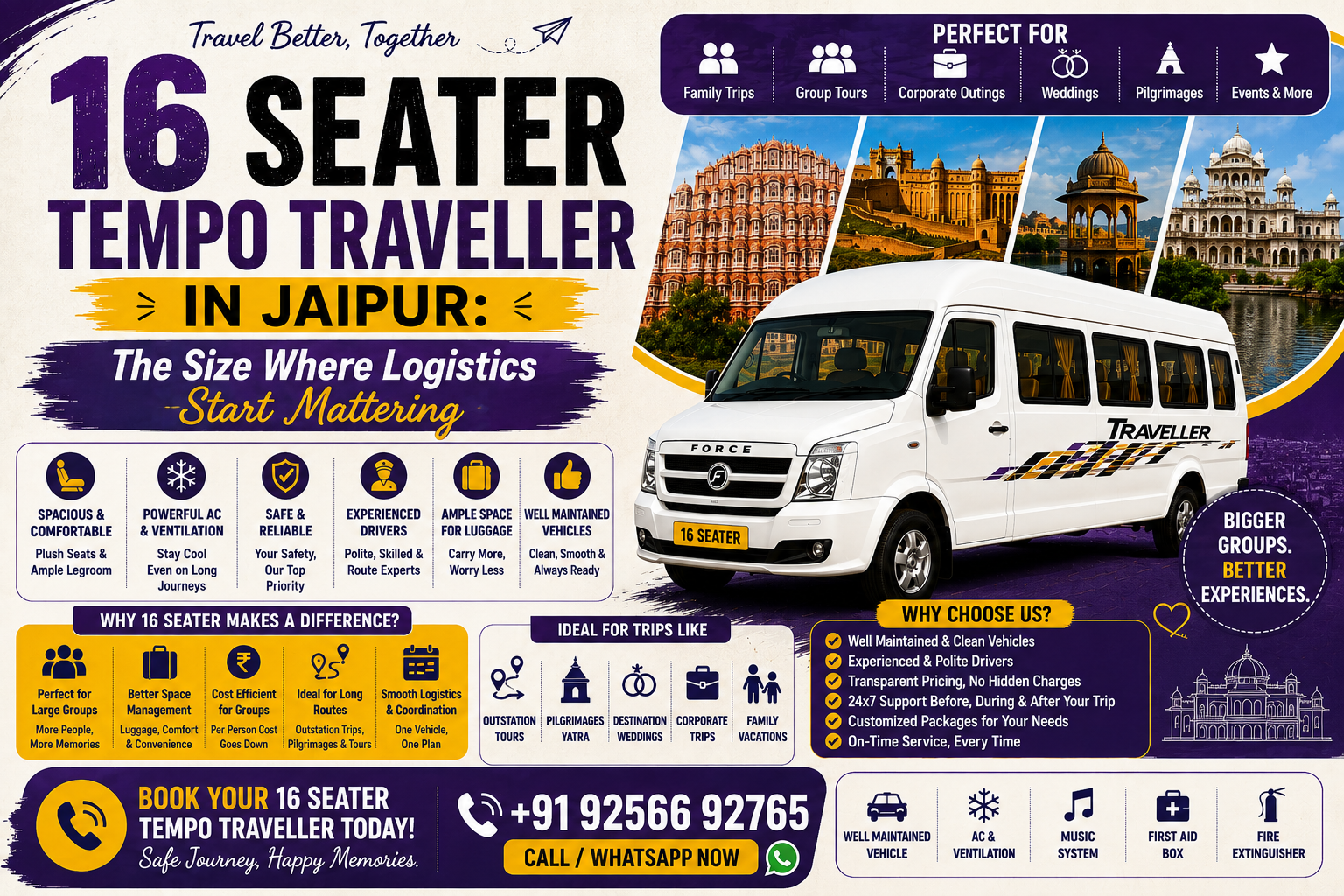
16 Seater Tempo Traveller in Jaipur: The Size Where Logistics Start Mattering
Up to twelve seats, a tempo traveller behaves like a large car. It goes where you point it, parks where you’d park anything, and turns around when it needs to.
At sixteen, that stops being true.
The 16 seater is built on the long-wheelbase Force Traveller body, and the extra length changes the vehicle’s relationship with Jaipur itself. It still drives fine. It still handles the highway comfortably. But it now has requirements — about where it can turn, where it can wait, and which hotel gate it can actually get through. Nobody mentions this while quoting, because it isn’t a problem for the operator. It becomes a problem for you, once, at the worst possible moment.
So this guide covers the seats and the luggage like any other, but it spends real time on the part that actually goes wrong at this size.
What Sixteen Seats Actually Buys
Sixteen passengers plus the driver. Rows of two-by-two down a longer cabin, with a four-across bench at the back.
The gain over a 12 seater isn’t just four more people — it’s that the whole group stays one unit. Below sixteen, a group of fifteen splits into a van plus a car, and that car always leaves late, always stops somewhere else, and always arrives after the rooms have been allotted without them. By day two you have two groups with two moods.
That single-cabin discipline is the actual product here, and for wedding parties, school groups and corporate movement it’s worth more than any feature on the list.
Luggage. This is where the 16 seater earns its keep. The boot behind the last row is shallow — the seats have been pushed back to fit sixteen, and that space came from somewhere. What saves it is the ladder frame, and therefore the roof carrier. Big suitcases go up top under a tarp and rope, the boot stays free for day bags and water crates, and the aisle stays walkable.
Sixteen adults with sixteen full multi-day bags is a workable configuration on this body with the carrier fitted. Without it, it isn’t a trip, it’s an argument at every hotel.
Tell the operator your suitcase count when you book — not “we have luggage,” an actual number. The carrier gets fitted and roped the evening before, instead of improvised at 5 a.m. while sixteen people stand around watching.
The Long Wheelbase Problem
Here’s what a 16 seater cannot do as easily as a 12 seater, and what to do about each one.
Old-city lanes. Chandpole, Johari Bazaar, the approaches around Tripolia — a long body plus market traffic plus a cow is a genuinely slow situation. It’s not impossible, it’s just not quick, and your driver will look for a drop point rather than a through route. Plan for a short walk into the bazaar rather than a door-side drop.
Hotel driveways. This is the one that actually causes trouble. Heritage properties and havelis in Jaipur, Jodhpur, Bundi and inside Jaisalmer fort were not designed around a twenty-foot van. Some have a gate the vehicle can’t clear; some have a courtyard it can’t turn in.
Fix it in one message. Before you confirm your hotels, send them: “We’re arriving in a 16 seater tempo traveller — can it enter, and where does it park overnight?” Ninety seconds of typing prevents the most common bad moment in this entire category, which is arriving at 9 p.m. with sixteen tired people and being told the van has to park somewhere four hundred metres away.
Monument and temple parking. Amer, Ranthambore gates, Nathdwara, Salasar during mela weeks. Large vehicles are often directed to separate lots further out. Not a problem — just build the extra walk into your timing so nobody’s rushing elderly passengers.
U-turns and reversing. Your driver needs room. On tight ghat sections and in crowded temple towns, this means occasional patience. Which brings up the point most people skip: ask about the driver, not just the vehicle. Has he driven this body on your specific route before? On the Mount Abu ghats or a Jaisalmer fort approach, that answer matters more than the RC year.
None of this is a reason to avoid the size. It’s a reason to book hotels and timings with the vehicle in mind, which almost nobody does.
Is Sixteen Your Number?
Book for your worst-case list, not the optimistic one. A seat added on the morning of departure costs far more than a seat booked four days earlier — and during wedding season it may simply not exist.
- Six to eight people. The 9 seater tempo traveller — easier to park, cheaper per day, still takes a roof carrier.
- Nine to twelve. The 12 seater tempo traveller, which is the sweet spot for family trips and standard office teams.
- Thirteen to sixteen. This size, and don’t squeeze into a 12 seater to save a little — thirteen people in twelve seats is a four-day problem, not a clever saving.
- Above sixteen. Go bigger. One full cabin always beats two half-empty ones on both cost and coordination.
The complete ladder across sizes and platforms sits on the tempo traveller on rent page.
16 Seater Tempo Traveller or 16 Seater Urbania?
At this size the comparison is sharper than at any other, because the group is large and the trips tend to be long.
The Urbania rides better, clearly. Monocoque body instead of a bolted frame, so less shudder over broken road, noticeably quieter at highway speed, and a lower step-in that sixteen people will each appreciate every time they board. After six hours, the difference isn’t subtle — it’s the difference between a group that arrives and a group that arrives worn out. The 16 seater Urbania is the top of that platform in Jaipur, and the 12 seater Urbania is the same idea for a smaller party.
The tempo traveller costs less and carries more. The roof carrier is the whole argument. The Urbania platform cannot take one, at all — every bag travels inside the cabin with you. For a corporate group with cabin bags, that’s irrelevant. For sixteen people at a wedding with sixteen suitcases, it decides the booking.
Short version: luggage is the problem, take the tempo traveller. Fatigue is the problem, take the Urbania. The wider Urbania rental range and the luxury Urbania rentals cover the premium end if comfort wins.
Trim: Where Two Quotes Diverge
Base. 2×2 pushback seats, dashboard blower. Fine for airport runs, guest shuttles and half-day city duty. Not fine for a Jaisalmer run in May — a dashboard blower physically cannot cool the back of a sixteen-seat cabin.
Roof AC. Ceiling ducting throughout. Between March and September in Rajasthan, treat this as your baseline rather than an upgrade. At sixteen seats the cabin is long enough that this matters more than at any smaller size.
Luxury. Proper recliners, curtains, LED lighting, clean upholstery, roof AC as standard — quoted as a luxury tempo traveller and worth the premium on any multi-day itinerary.
And keep this straight, because it costs people money every season: body and seating are separate decisions. A plain body can carry good seats; a good body can arrive with tired ones. Ask about both, by name, in the same message.
Routes Where the 16 Seater Earns It
Wedding movement. Guest pickups from the airport and Jaipur Junction, hotel-to-venue runs, the shuttle that goes back and forth four times in an evening. This is the most common use of the size in the city, and the reason it books out first during muhurat weeks.
The Golden Triangle. Jaipur–Agra–Delhi over three or four days with a large group, bags loaded and unloaded twice daily. The roof carrier does more work on this itinerary than anything inside the cabin — a structured Golden Triangle package with tempo traveller removes most daily route arguments before they start. If comfort leads instead, the Golden Triangle with Urbania is the premium version of the same trip.
Jaipur–Jodhpur–Udaipur and Jaipur–Jaisalmer. Long highway hours where seat quality and AC stop being spec sheet lines. Roof AC is not optional on the desert stretch.
School, college and corporate groups. Fixed headcount, light bags, defined timings. This is the requirement the size was written for.
Temple circuits. Khatu Shyam Ji, Salasar, Nathdwara, Ajmer Sharif, Pushkar. Mixed ages and 4 a.m. starts — and the one route type where you must confirm large-vehicle parking for your exact dates, because mela weeks rewrite the plan for everyone.
Mount Abu and the Aravalli ghats. Long body, gradients, hairpins. Ask for a newer vehicle and a driver who has done the route.
Before You Pay — The Checklist
- Hotel clearance. Confirm with every property that a 16 seater can enter and park. Do this before you book the hotels, not after.
- RC year, as a plain number. How fast that answer comes back tells you a lot about the operator.
- AC type — roof-mounted or dashboard blower. At this cabin length, ask directly.
- Roof carrier fitted, with your actual suitcase count stated in advance.
- Driver’s route experience, specifically for ghat sections or old-city work.
- Kilometre cap and the beyond-cap per-km rate, in the same message as the quote. Usually 250–300 km per day, and multi-city Rajasthan itineraries cross that routinely.
- State permits and entry tax named inside the quote if Agra, Delhi or Gujarat are on the route — larger vehicles cost more to take across state lines.
- One all-inclusive total covering tolls, parking, driver allowance, night charges and GST.
Frequently Asked Questions
How many people fit in a 16 seater tempo traveller? Sixteen passengers plus the driver. With the roof carrier fitted, sixteen adults with full multi-day luggage is a normal configuration. The four-across last row is the least comfortable position on long routes, so rotate seating across multi-day trips.
Can a 16 seater go inside Jaipur’s old city? It can, but slowly, and door-side drops aren’t always possible in the markets. Plan a drop point and a short walk rather than a through route.
Will it fit at my hotel? Often yes, sometimes no — heritage properties and fort-area hotels are the usual exceptions. Ask the hotel directly before booking, and ask where the vehicle parks overnight.
Does it have a roof carrier? Yes, and at this size it isn’t optional because the boot behind the last row is shallow. Confirm it’s fitted for your specific booking.
16 seater tempo traveller or 16 seater Urbania? Tempo traveller for luggage capacity and a lower daily rate. Urbania for ride quality on long highway hours, accepting that no bags can travel on the roof.
How early should I book? Four to five days in normal season, and ten to fifteen around wedding muhurats, Diwali, the Pushkar fair window and long weekends. Large vehicles are the first to get committed and the last to be released.
Final Word
The 16 seater is a straightforward vehicle with one complication, and the complication is length. Everything that goes wrong at this size goes wrong because somebody planned the trip for a group and forgot to plan it for the van.
So do both. Count your people with their bags in front of you. Ask your hotels whether it fits before you pay them. Confirm the roof carrier with a real suitcase number, ask whether the AC is on the roof or the dashboard, and get one all-inclusive figure with the kilometre cap attached.
Do that, and sixteen people travel as one group for four days — which is the only reason anyone books this size in the first place.

